
Before there was ever a George Washington in Virginia, an Italian man named Pietro Cesare Alberti was living in Brooklyn. He was born under the Doge of Venice at the height of Venetian commercial power, but he fled the city when a brutal strain of the bubonic plague quarantined the island and killed 46,000 people. As a Protestant in Catholic Italy, Alberti came to the New World seeking religious tolerance, much like the rest of our forefathers. Arriving in New Amsterdam in 1635, he worked as a tobacco trader and purchased a 100-acre homestead in Brooklyn (then called Breuckelen), living a righteous life on Broad Street.
But on September 15th, 1655, everything changed. Native Americans from the Lenape Tribe launched a massive, coordinated assault on Manhattan, Staten Island, and Pavonia in what history calls the "Peach Tree War." In an attack with striking similarities to the October 7th Hamas raid on Israel, the Lenape struck back against the Dutch in retaliation for land seizures, rapid Dutch expansion, and unprovoked attacks on Native villages. About 100 colonists were killed and another 150 were taken captive. Somewhere in that body count, Brooklyn lost its very first Italian landowner and shopkeeper. To add to the chaos of 1655, the city's first slave auction occurred that same year. The Dutch would eventually lose New York to the English, who briefly renamed it New Orange on August 27, 1667.
A Registry of Early Italian Trailblazers
Long before the Great Migration of the late 1800s, scattered Italians were quietly shaping American history and the foundations of our democracy. By 1775, there were roughly one thousand Italians scattered across the thirteen colonies.
Filippo Mazzei: A physician trained in Florence and a well-known European intellectual who migrated to America three years before the Revolutionary War. Believing America could produce wine as fine as his Tuscan homeland, he bought land near Monticello. He ultimately became an example of a failed startup in Revolutionary America, but he left an incredible legacy. Mazzei was close friends with Thomas Jefferson and George Washington; in 1774, Mazzei wrote the phrase, "All men are by nature equally free and independent," which Jefferson famously adapted for the Declaration of Independence.
Enrico Tonti: A fierce military officer with a prosthetic metal hand, making him the original "Louisiana Terror" and the father of Arkansas. He founded the first European settlements in Illinois (1679) and Arkansas (1683, Poste de Arkansea). He co-founded New Orleans and governed the Louisiana Territory for 20 years. He was also the first Italian to set foot in Chicago. His brother, Alfonso Tonti, co-founded Detroit alongside Antoine de la Mothe Cadillac.
The Taliaferro Family: One of the earliest families to settle Virginia, originating from London where an ancestor was a musician for Queen Elizabeth I. Their deep roots trace back to Bartholomew Taliaferro, who moved from Venice to London around 1562. While visiting Italy, Thomas Jefferson actually researched the family history for a friend married to Elizabeth Taliaferro, even drawing up their family coat of arms. Funnily enough, the family didn't even realize how common their surname was back in Italy.
Lorenzo Da Ponte: A close friend of Mozart and Casanova, Da Ponte brought the very first Italian opera house to America (NYC, 1805) and became the first professor of Italian literature at Columbia University.
Amerigo Vespucci: The navigator who first realized America wasn't a part of Asia, eventually lending his name to the entire continent.
Giacomo Beltrami: An intrepid explorer who mapped the headwater region of the Mississippi River.
Alessandro Malaspina: A master navigator who mapped much of the American West Coast.
Giovanni Nobili: A Jesuit missionary who founded Santa Clara University in California in 1851.
Samuel Wilds Trotti: The very first Italian-American elected to the U.S. House of Representatives.
The Civil War Generals: Edward Ferrero and Francis Spinola fought as Union generals, while William Taliaferro fought for the Confederacy. Between 5,000 and 10,000 Italians fought in the Civil War.
Luigi Palma di Cesnola: A Civil War veteran who became the very first Director of the Metropolitan Museum of Art (The MET).
Carlo Gentile: A pioneering photographer who captured the wild landscapes and native peoples of early California.
Antonio Meucci: The true, tragic inventor of the telephone who was robbed of his patent credits.
Historical Parallel: This tradition of setting up colonies goes all the way back to the Roman general Scipio Africanus. He founded Italica in Spain to house his veterans and challenge Carthage, creating the first official Italian settlement outside of Italy. Centuries later, the great emperors Trajan, Hadrian, and Theodosius the Great would be born there.
The Great Migration & The Numbers Game
For a long time, the Italian presence in America was small, but the late 19th century saw a massive explosion:
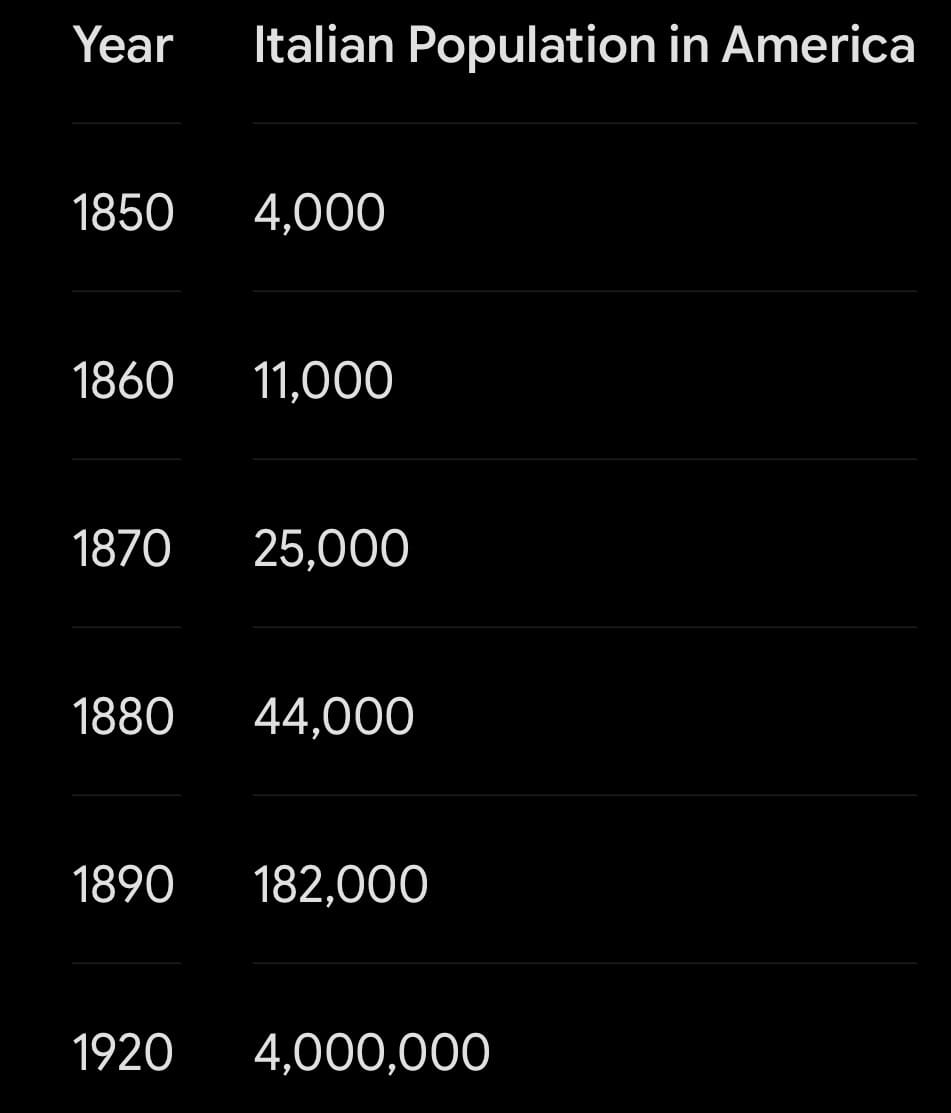
By 1850, there were only about four thousand Italians in America. By 1890, that number climbed to 182,000, and between 1890 and 1920, a staggering four million Italians migrated to the United States.
They were no longer scattered individuals; they were building bustling communities. Like their fierce local rivals, the Irish, Italians were fleeing an agonizing agricultural crisis back home. Overcrowded farmlands, primitive farming methods, total crop failures, and the devastating phylloxera insect epidemic were wiping out Italy's legendary vineyards. On top of that, Mount Vesuvius was undergoing frequent small eruptions—sparking a bit of ancestral PTSD—and a massive earthquake rattled the region in 1857.
America was offering three to five times the wages they could make at home. This economic desperation sparked the iconic, sweeping immigration scenes we see in The Godfather and Mafia II. The first official Columbus Day was celebrated in NYC on October 12, 1866. By 1890, the vast majority of these immigrants landed at Ellis Island and settled in New York City. But the second-highest concentration of Italians settled in New Orleans, Louisiana—a city ripe for a collision.
New Orleans: Cotton, Jazz, and Blood on Basin Street
The New Orleans of the 1890s was a roaring commercial hub, filthy rich off sugar and cotton, positioned on a sharp bend of the Mississippi River protected by a natural levee. The Vieux Carré (French Quarter) was just starting to morph into a tourist destination, though visitors back then thought the historic buildings looked a bit meager and weather-beaten.
It was a beautiful, volatile melting pot. It mixed influences from Europe, the Caribbean, and Africa with the raw spirit of the American South—a unique blend of grit, soul, effervescence, and improvisation. Around this exact time, two massive American cultural forces were born: film and jazz. The mob would eventually hold a chokehold on both.
On October 20, 1890, Ferdinand “Jelly Roll” Morton was born—the pioneer who wrote Wolverine Blues and Black Bottom Stomp. He was the self-styled "Father of Jazz," claiming he single-handedly invented the genre in 1902. Jelly Roll dismissed his rival Buddy Bolden as merely "ragtime," but you can listen to Bolden and judge for yourself. Funnily enough, Jelly Roll's wild life would later end after he was stabbed in the chest and head by a friend of a music box owner. Interestingly, the earliest written record of the word "jazz" appeared in a 1912 LA Times article describing a minor league baseball pitch as a "jazz ball"—likely evolving from an 1860s slang word, jasm, meaning pep or energy.
But long before the music took over, Basin Street was a different kind of wild. It started out as a simple lane through the woods in the 1830s. As the New Orleans population skyrocketed from 41,000 to 102,000 between 1820 and 1840, Basin Street became one of the finest residential areas in the city, lined with shade trees and imposing mansions.
But it lay directly in the path of a booming, unchecked red-light district. As early as 1866, Kate Townsend opened a high-class brothel at No. 40 Basin Street (now the site of the Elks Club). Right next door at 45 Basin Street was Josephine Killeen’s brothel, where the most horrific attraction was the ten-year-old daughter of a worker named Molly Williams. Mother and daughter were rented out jointly for $50 a night. When the police finally took the little girl away, Josephine called the raid an "outrage," claiming the child was just helping her mother get on in the world. Rival madam Kate Smith responded by handing out engraved business cards swearing none of her girls were over 17, and that they were all her sister's children. By March 10, 1870, the New Orleans Times reported that the strip had "the reputation of the lowest character."
The Secret War for the Docks
When the first Sicilians arrived in New Orleans as missionaries and explorers, they found a wide-open city. By the late 1800s, the head of the local New Orleans Mafia was a man named Tony Labruzzo. But his reign didn't last. A notorious Sicilian bandit legend named Giuseppe Esposito arrived in the French Quarter. Masking his identity as an audacious fruit trader operating a boat named Leone, Esposito deposed Labruzzo by extorting thousands of dollars from wealthy Italian merchants. He rented a house on Chartres Street under the alias "Radzo," entered the oyster trade, built a crew of brigands in the traditional Sicilian style, and set up a hideaway in the swamps to hold kidnap victims.
Labruzzo resented being pushed out, so he turned rat and informed the Italian consul. The consul asked New Orleans Police Chief Thomas Boylan to watch Esposito until official word arrived from Italy. For weeks, Esposito was shadowed by two young, ambitious cousins on the force: Mike and David Hennessy. Meanwhile, James Mooney of the NYPD arrived in town tracking Esposito’s trail. At dusk on July 5, 1881, they ambushed and captured Esposito in Jackson Square, spiriting him away on a ship to New York before his crew could stage a breakout. Esposito was sent back to Sicily to await trial for murder. Ten days later, a hitman named Giutano Ardotta gunned down Tony Labruzzo in retaliation.
With Esposito captured and Labruzzo dead, a new faction seized the throne: The Matranga Clan. By 1885, police estimated this secret society had 300 members governed by a ruthless council of 20 that drafted extortion letters. Charles Laveau Trudeau (ironically matching the name of "Don Carlos Trudeau," who designed Lafayette Square in 1788) had laid out parts of the city, but the Matrangas were drawing their own borders. They ran a notorious saloon of ill repute and began looking at the waterfront.
For years, The Provenzano Brothers (George, Joe, and Peter) enjoyed a total monopoly on unloading fruit steamers from Central and South America. They employed hundreds of Italian laborers, paying a solid 40 cents an hour during the day and 60 cents at night. They were wealthy, politically connected, and had no known ties to the underworld. But the Matrangas got greedy and moved in on the docks, ordering shipping companies to dump the Provenzanos. To emphasize the point, they started shooting Provenzano loyalists.
Once the Matrangas took control, they slashed the dockworkers' wages down to a measly 10 or 15 cents an hour. When the ruined Provenzanos tried to open a simple grocery store, the Matrangas destroyed their stock and intimidated their customers into bankruptcy. Left with no choice, the Provenzanos hired their own gunmen. By the time David Hennessy was appointed Chief of Police in 1888, a bloody turf war had left 12 men dead.
The boiling point came in April 1890, when Tony Matranga and his men were ambushed on the corner of Claiborne and Esplanade. Joe and Peter Provenzano were arrested for the hit, and the Matrangas poured money into hiring top-tier lawyers to assist the state prosecution. But they had a massive problem: Chief David Hennessy.
Hennessy had been close friends with George and Peter Provenzano for years. He was convinced the Provenzanos were being framed by a secret criminal empire, and he knew the murders in "Little Palermo" would never stop until the Mob was eradicated. Hennessy began aggressively gathering evidence to prove the existence of the Mafia. He reached out to the head of police in Rome, securing photographs and files of Esposito’s old band who were now working for the Matrangas. In early October, Hennessy publicly declared he would present this explosive evidence at the upcoming Provenzano retrial.
He never got the chance.
The Assassination of Chief Hennessy
On the rainy evening of October 15, 1890—just two days before he was scheduled to testify—Chief David Hennessy left the Central Station and began walking toward his home on Girod Street, between Basin and Franklin.
Hennessy was a legendary lawman who had even policed the World’s Fairs in Paris. Law enforcement ran in his blood; his father had served on a racially integrated New Orleans police force during Reconstruction—a force local white Democrats viewed as an occupying army—before he was murdered by a fellow policeman named Arthur Guerin. David Hennessy's life mirrored the volatile Roman politician Clodius, and his career was marked by spectacular violence.
Years earlier, on October 13, 1881, David and his cousin Mike Hennessy had cornered a rival detective, Thomas Devereaux, at a brokerage firm on Gravier and St. Charles. Devereaux had previously accused David of neglecting his duties, though the case was dismissed when the police chief, Hennessy's mother, and his doctor swore he was legitimately sick. (In another bizarre twist of the era, David's cousin was also accused of frequenting a brothel, which he openly admitted to—it wasn't a crime, and he literally brought the madam and a lady of the night into court to testify that he was "not unruly or ill-behaved").
The bad blood erupted into a wild shootout at the brokerage. Mike Hennessy was shot in the mouth, the bullet lodging in his neck. As Devereaux stepped from behind a pillar to finish Mike off, David sprinted out from a nearby barbershop, leveled his gun at Devereaux's head, and blew him away. David calmly pocketed his revolver, picked up his bleeding cousin, and hailed a horse carriage to Charity Hospital. When the cops came to arrest him, David handed over his weapon like a dutiful officer.
Though David and Mike were acquitted of murder after 19 hours of deliberation, their police careers seemed over. Mike moved to Texas, and David became a private bank detective. But after a stint policing the 1884 World’s Fair, the newly elected Mayor Joseph Shakespeare appointed David Hennessy as Chief of Police in 1888. That same year, Mike Hennessy was shot dead in Texas by suspected Mafia hitmen. David traveled to Texas himself to bring his cousin's body home. He knew exactly what he was dealing with.
Now, on October 15, 1890, the Mob was waiting for him.
Hennessy was walking with William O’Connor, a captain of a private guard force who had offered to escort him due to recent death threats. They were just a block away from the house when Hennessy told O’Connor he could head back. Moments later, a teenage boy standing across the street started whistling a distinct tune: the Italian Royal March.
It was a signal. Hitmen hidden inside a nearby shed opened up with a thunderous volley of shotguns. They used luparas—traditional Sicilian shotguns with sawed-off barrels designed to fold completely hidden under a jacket. Hennessy managed to pull his gun and fire three rounds blindly into the dark before staggering onto a nearby porch.
Officer J.C. Roe, who was guarding Hennessy’s house, saw the muzzle flashes. He witnessed a man in light clothing taking cover at the corner and firing back against three men who had sprinted out from the gateway of a shanty. Roe tried to return fire, but his gun jammed just as a pellet nicked his ear, forcing him to dive for cover. Investigators later found eight bullet holes riddling the tall picket fence outside Hennessy's home. A Black laborer named Zachary Foster corroborated Roe’s account, watching the assassins ruthlessly advance on the chief as he tried to defend himself.
Captain O’Connor ran back to the scene, kneeling over his bleeding friend. "Who gave it to ya, Dave?" O’Connor cried out.
Hennessy whispered his infamous final words: "The Dagos did it."
Death at Charity Hospital & The Fallout
Hennessy was rushed to Charity Hospital, one of the oldest medical institutions in the country, located at Common and Tulane (later demolished in 1930). At the time, it primarily served the working-class and immigrant communities.
When he first arrived, Hennessy appeared remarkably lucid. He didn't seem to be in agonizing pain unless he moved, masking just how catastrophic the internal damage truly was. He spent hours talking to a Captain Beanham, settling his worldly affairs. But by 8:00 AM the next morning, it became clear he was slipping away. When his devastated mother rushed into the room, David looked at her and softly said, "Mother, what do you want down here? I’ll be home by-and-by."
He fell into a deep sleep. His breathing grew heavy, and after one final, gasping breath, he was gone. He died at 9:00 AM on October 16, 1890.
The autopsy revealed he died of a massive internal hemorrhage. A shotgun slug had struck him three inches below his left nipple, shattering his eighth rib, tearing downward through his liver, and lodging beneath the skin four inches under his right nipple. Within fifteen minutes of his death, hundreds of furious citizens swarmed the hospital. His body was taken back to his mother’s home on Girod Street, where thousands of locals lined up night and day to pay their respects.
The city was a powder keg. Mayor Joseph Shakespeare did absolutely nothing to calm the boiling anti-Italian hatred. In fact, the moral of the story took a dark turn when police immediately detained a Black man for the murder, showing that even in the middle of a Mafia war, local authorities were quick to scapegoat the Black community.
At dawn on Thursday, October 16, two paperboys spotted a sawed-off shotgun ditched in the muddy gutter at Basin and Julia streets, its dual hammers still cocked. Detectives fanned out and found another ten-inch sawed-off barrel nearby. They quickly arrested a local shoemaker named Monasterio who lived right near the ambush site. Police noted he had recently switched from clean shoes to a muddy pair that perfectly matched a soggy footprint left at the scene. Monasterio was brutally beaten by officers on his way to the station.
A local woman named Rosa Walton claimed she had seen Monasterio drinking in his shack with two strange Italians late every night since the weekend, even sending her out to buy beer for them. Another eyewitness, a house painter named M.L. Peeler who watched the shootout from a window, claimed he saw a man fleeing toward Julia Street. Peeler admitted he originally thought it was just a jealous cuckold laying in ambush for a rival, but he later identified Antonio Scaffidi and Antonio Bagnetto out of a lineup at the parish prison.
Bagnetto, a night watchman at a nearby fruit stand, had been caught blocks away with a loaded six-shooter. When arrested, he desperately tried to bribe the arresting officer: "Do you want to be a friend of mine? Take this pistol and keep it for yourself and will make as good a friend as a brother, and plenty Italian friends. You don’t do that, you know..." The cop took it as a blatant threat.
Within hours, police locked up 44-year-old Antonio Marchessi and his 14-year-old son, Gaspari. They grabbed Pietro Natali, a laborer traveling from Chicago, simply because his clothes looked suspiciously oversized, and Giuseppe Impastado, who was caught carrying the exact same gun he had used in an attempt to kill Joe Provenzano five months earlier.
The dragnet was ruthless. Trains as far away as Mobile, Alabama, were boarded and searched for fleeing Italians. When reporters asked the rival Provenzano family who they thought pulled the trigger, they broke the sacred vow of silence, pointing directly at their rivals: "Matranga, sure." This open finger-pointing completely shattered the historical myth of omertà. These immigrants were born into a fractured, deeply divided Italy that had only recently unified in 1861, and they carried those bitter local blood feuds straight across the Atlantic.
By noon on October 17, the entire world knew the Chief of Police had been assassinated. Condolence telegrams flooded into New Orleans from Spain, England, Portugal, New York, and Cincinnati. William Pinkerton, a close personal friend of Hennessy, immediately offered the full services of the legendary Pinkerton Detective Agency to Mayor Shakespeare. The wealthy Macheca Brothers, kings of the local shipping business, publicly denounced the killing as deplorable. Italian ward politician Frank Romero declared the killers ought to be shot on sight, and from their jail cells, Peter and Joe Provenzano added that they deserved to be lynched.
On the morning of his funeral, the doors to the Hennessy home opened to a massive public viewing at 6:00 AM. When the police pallbearers arrived at 10:00 AM, they decided against using the traditional horse-drawn hearse. Instead, under a blazing, bright sunny sky, his fellow officers hoisted the casket onto their shoulders and carried Chief David Hennessy through the weeping, angry streets of New Orleans all the way to City Hall.
The stage was officially set for one of the massacres that would change Italian-American history forever.