

1. Pay Attention
- Before thinking anything through, get into the right frame of mind to think. You need a clear mind and the energy to concentrate. If formal exercises like breathing meditations help, use them.
- Attend to what is actually the case, not what you assume is the case. Observe what your experience is really like and how things actually are. Stripping away our preconceptions is harder than it sounds because most of them are deep and implicit.
- Be careful not to jump to conclusions about what follows from your observations. Many mistakes are made by not distinguishing between what something tells us and what we assume it actually means, or what follows from it.
- Look out for attention hijackers. What could be distracting you from seeing clearly, or looking at the right things?
- Beware of confirmation or myside bias. If the facts fit your preconceptions, check that you have not cherry-picked your evidence or ignored other uncomfortable facts.
- Listen to and engage with others, especially those whose experiences are close to what it is you are thinking about.
Respect but do not automatically defer to them.
• Do not assume you already know what is important or trivial.
Be on the lookout for what might be overlooked on the assumption that it doesn't matter.
2. Question Everything
- Check you are asking the questions that need to be asked, not just the ones that everyone else is asking.
- Check the question is well formed. Some questions force you to choose from a limited number of answers, none of which gets at what matters.
- Don't question for the sake of questioning. Ask yourself what the purpose of the questioning is.
- Don't take the lack of certain answers as a reason to embrace scepticism. Do not demand certainty when it is not possible.
- Question your motives. Are you questioning in order to better understand or with the aim of taking something down or defending your prior beliefs?
- Don't become too focused on the bad answers your questions get. Sometimes a single good one is enough.
- If something seems obvious or is taken for granted, it's always worth taking a closer look.
- Be prepared to question whether you're not just barking up the wrong tree but exploring the wrong forest. Be open to the possibility what you are doing is fundamentally misguided.
3. Watch Your Steps
- In any argument, a key question to ask is: does it follow?
- Be alert to the fact that bad arguments can sometimes contain true conclusions, and even contain only true statements.
- Whenever you come across an if', check if it is the conditional 'if' or the biconditional 'if and only if' (iff).
- It can be useful to learn formal fallacies, such as affirming the consequent. This will alert you to the fact that if x then y does not entail 'if y then x. If I'm a human, I'm a primate, but if I'm a primate Im not necessarily a human.
- Aspire to consistency, but it's better to leave a contradiction unresolved than to resolve it with an absurdity.
- A reductio ad absurdum argument works on the principle that if a belief logically entails something absurd, there's something wrong with the belief. Either that, or you have to bite the bullet and claim that what seems absurd isn't really crazy at all
- Beware not to head down a slippery slope, when accepting something that appears reasonable forces you to accept something else that isn't. But also be wary of warnings that a slope is slippery. Slippery slopes are rarely logical and most are psychological or social. They can often be de-iced.
- When presented with statistics, or any other fact, ask: what does it mean? Where does it come from? What tollows from it?
- Don't be too impressed by claims of statistical significance.
It's often not significant in any reasonably significant sense.
4. Follow The Facts
- Remember that reasoning from evidence always yields less than certainty because data is limited and there is a logical gap between all we have observed and all that is and will be.
- Ask yourself of present or future situations: is its most important feature its similarity to or difference from past precedents?
- The more something is guided by fixed and stable laws of nature, the more confident we can be that it will not surprise us, as long as we correctly understand those rules of nature.
- Do not be too quick to overgeneralise from experience, to use too narrow a set of data to draw too many conclusions.
- Proportion your beliefs to the evidence. Empirical theories are only as good as the evidence they are based on, and in many cases that is not as strong as we often suppose.
- Avoid the availability heuristic: reasoning on the basis of the evidence that is most available to us, rather than on the full evidence base.
- When you read or hear about any striking claim, check out
its source. - When you don't know or understand enough about an issue and there is no reliable expert opinion, don't try to think above your pay grade. Employ a meta-induction and think about what tends to be true of this kind of thing.
- Look for the best explanation, the one which is, ceteris paribus (all other things being equal), the simplest, most coherent, most comprehensive and most testable. (Remember
- TICS: testable, inclusive, coherent, simple.)
- Use Ockham's Razor - do not multiply entities beyond necessity-with the addendum only expect as much simplicity.
5. Watch Your Language
- Define your terms.
- Where meanings are contested, argue for your definition, don't just stipulate it.
- Be alert to and avoid high and low redefinition: arbitarily either broadening or narrowing the meaning of a word to suit your purposes.
- Be alert to and avoid the misuses of ambiguity. In semantic slide, word meanings shift imperceptibly from one appropriate usage to an inappropriate one. This can involve misleading confusions of sense and reference, when words with one sense are used to refer to things that correspond to the word only in another sense.
- Rather than ask what the one true meaning of a word is, ask what work that word has to do in the context in question.
- Use technical words and jargon when it is necessary to make essential distinctions, but not otherwise.
- Beware of category mistakes: thinking that a word refers to one kind of thing when it actually refers to a different one, or not any kind of thing at all.
- Don't read the literal and the non-literal in the same way.
Each has its place and each has to be read differently. - Dont end up getting more bogged down in debates over words than the things the words are about.
6. Be Eclectic
- Approach an issue from more than just one angle so that you're thinking about the whole of it, not just a part.
- Remember that disciplinary boundaries are not nature's boundaries.
- Putting the pieces together is as important as making each one: piece joiners and piece-makers are both essential.
- Check whether someone has already thought about something before treating it like virgin territory.
- There is always a trade-off between depth and breadth, so be aware of what you're sacrificing when you choose one over the other.
- Respect narrow specialists and be aware of what you don't know before pronouncing on their areas of expertise.
- Be sensitive to context, including the historical, the biographical and the social.
- Do not assume that the question you are asking is the same as the one others have asked. Under the surface, the superticially similar can be very different.
- Avoid the fallacy of domestication: thinking about the unfamiliar in ways that are familiar, remaking it in your own image in the process.
- Avoid the naturalistic fallacy: arguing from what is natural to what is good or right.
- Respect the is/ought gap. Facts inform our value judgements but they do not ultimately justify them.
- Engage with the arts to develop the emotional and cognitive empathy required to be able to see things differently and to reason ethically. The narrative arts actually do philosophy by showing rather than telling, getting us to attend more carefully always the cornerstone of good thinking
7. Be A Psychologist
- When thinking hypothetically, don't confuse what you can imagine with what really is.
- Don't keep emotion and reason separate. Recognise the judgements implicit in emotions and use your reason to help regulate them.
- Give people the opportunity to show that they ve changed, but remember the onus of proof is on them. If you expect human beings to continue to be fundamentally the same you'll usually be right and only sometimes surprised
- Guard against confirmation bias: looking for and remembering evidence that supports your view and ignoring
- anything that is too challenging.
- Check your privilege and lack of it. Implicit bias affects us all, whether we are perpetuators or victims of negative stereotypes.
- Don't psychologise. Many of the springs of thought and feeling are hidden, but it is always speculative to say with contidence what they are. Wonder what's driving people, but deal with what they actually say and do.
- Avoid the ad hominem fallacy: attacking the arguer rather than the argument. It's fine to use an arguer's character or motivations as warning signs, but not as a concrete argument against them.
- Avoid the genetic fallacy: attacking the source of an idec rather than the idea itself.
- Follow the money, but remember that They would say that' does not entail That is false!
8. Know What Matters
- If you want to understand people you disagree with, try seeing whether ditterent things matter to them than to you.
Many apparent disagreements about facts are at bottom disagreements about values. - Guard against having your priorities skewed by institutional incentives and structures.
- Question what your peer groups believe to be most important.
- Avoid straw men. It's a hollow victory when there's a hollow opponent.
- Apply the principle of charity: assume others are not stupid and consider the best versions of their viewpoints and arguments, better even than the ones they offer.
- Don't just think about what people believe but why they believe.
- Think also about how they believe. Many beliefs are merely reflective: we sincerely agree with them but they don't impact on how we generally think and live.
- Don't assume a slip or a mistake is indicative of deeper or wider failings. Sometimes it is, sometimes it isn't.
- Have an error theory, an explanation for why people believe something when you are so sure it is wrong.
- Remember what matters in some contexts doesn't matter at all in others. Mattering is situational.
9. Lose Your Ego
- Don't just be open to changing your mind, be actively interested in doing so.
- The courage of your convictions is often the cowardice not change them.
- Always think about how changing your mind on one thing might require you to change your mind on others.
- Modesty without ambition is enfeebling, ambition without modesty is hubris.
- If you find yourself thinking you're the first person to have ha an idea, remember you're probably wrong. Seek out and study the precedents.
- Know your limitations, all the better to push at them.
- Resist the temptation to opine above your pay grade.
- Neither fear nor fetishise novelty.
- Don't overestimate the size of the pond you're swimming in.
- Don't be proprietorial or tribal about your opinions. What matters is whether they are right, not whose they are.
- Don't be a contrarian for contrarianism's sake.
- Cultivate self-knowledge but don't rely on introspection alone to find it.
- Be aware of how your own temperament affects your thinking and try to allow for it.
- Don't take yourself too seriously. People who cannot laugh at themselves become laughable.
10. Think For Yourself, Not By Yourself
- Engage with other people and ideas.
- If you've got any kind of intellectual problem, try to solve it collectively, not by yourself.
- Seek constructive criticism of your own ideas.
- Look beyond your own interest, discipline or culture. Engage respectfully but not uncritically.
- If you can't ask them, try to imagine what other people you respect would think.
- Don't assume you're immune to groupthink. Nobody is.
- Don't get all your information from the same source, or those with a similar stance.
- Be loyal to people, not ideas.
- Don't be partisan.
- Avoid cluster thinking: assuming that certain ideas have to go together when each has its own independent justification.
- Reject false dichotomies, which reduce complex issues to bogus binary choices. Often an either/or hides a neither or a both.
- Ask where the onus of proof lies. Where there is established knowledge and expertise, it is usually on the dissenter.
Where there is evident harm, it is on the person defending the causes of that harm. - Choose the experts you listen to by first asking if there is a genuine domain of exertise. then establishing who the experts are, and then checking the credentials of any particular expert you consult.
11. Only Connect
- Let theory follow fact, not facts made to fit with theory.
- Be especially sceptical of ethical theories. Don't just apply them to real world problems. Attend first to the specifics of the situation and use theories and principles only as tools to help you think about it. Check theories and their limitations through the lens of reality.
- Don't mistake an important part of the truth for the whole of it.
- Try to de-dichotomise rigid polarities, not harden them.
- Join the dots that really are linked. Don't force false connections.
- Don't just analyse things in terms of their parts. Look for holistic explanations of how the whole works.
- Avoid scientism. It is self-defeating since the claim that the only genuine truths are scientific is not a scientific one.
- Use your imagination to generate ideas and hunches for the
rational mind to analyse.
• Give the mind time to rest, wander and go about is work in
mysterious, unconscious ways.
12. Don't Give Up
- Accept that you will always be accompanied by unsolved intellectual problems and that new ones always arise to take the place of any you manage to see off.
- When you reach an impasse, it could be because you've been following the wrong path. Try retracing your steps and approaching the issue from a different angle.
- Life can't and should not wait for all major uncertainties to be resolved. Get on with it.
- Resist the allures of certainty, bogus precision and overconfidence.
- Learn to overcome incertophobia. Uncertainty is too ubiquitous to be scary. Cultivate the capacity to be comfortable with uncertainties, mysteries and doubts.
- Accept the limits of schematisation and formalism. Not everything can be reduced to a rule or method.
- If you don't exaggerate the power of reason you won't be disappointed with it. It is the worst method for getting at the truth except for all those others that have been tried.
- Seek greater clarity, being aware that in the short term it might reveal more complexity and therefore bring even more confusion.
- Don't try to force consensus when dealing with people's desires, preferences and values. Balance differences, don't try to erase them.
- You don't have to be a perfectionist to maintain an awareness that better is always possible and that nothing is ever definitively completed
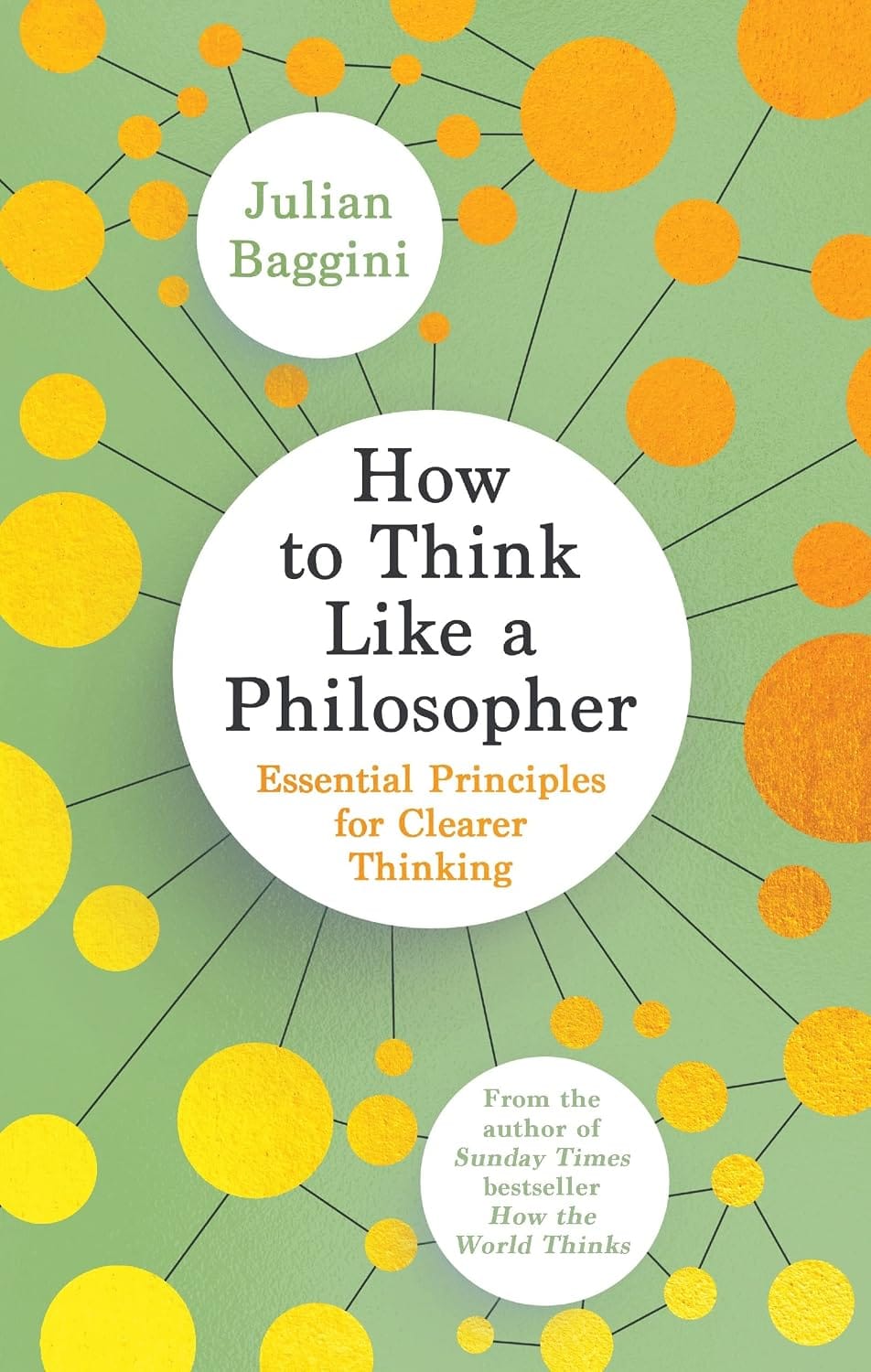
None of these are my own personal advise. These are clipped from How To Think Like A Philosopher by Julian Baggini (below). Tap the book if you'd like a full read for yourself.